About this blog

Accessible legal tips, know-how and news for anyone with a complaint or legal issue from Stephen Gold, author of The Return of Breaking Law, the book

Showing posts with label child welfare cases. Show all posts

Thursday, 16 June 2022
Friday, 21 January 2022

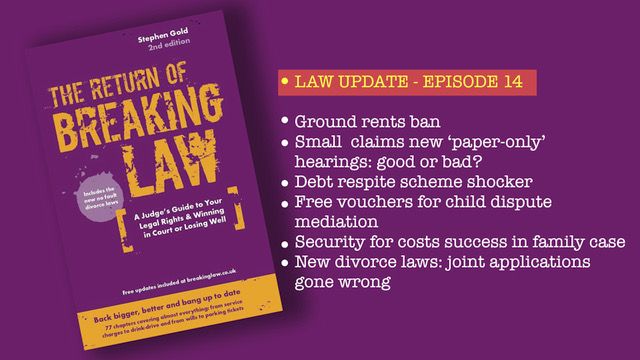
CHILD DISPUTE MEDIATION: FREE £500 TOKENS FOR COST

Involved in a child dispute? Reckon there is a reasonable chance that the intervention of a trained and independent mediator may result in a settlement with the other parent and avoid a contested court hearing? The government has been dishing out tokens worth £500 a go to couples to pay the cost of this form of mediation or at least to go towards the cost where the arguments are about how much contact, whether your son should wear short or long trousers, whether he should be kept to a vegan diet, which school he should attend, whether he is watching too many box sets......   There is no means test:millionaires qualify. I wrote about the scheme at https://www.breakinglaw.co.uk/2021/08/child-dispute-scheme-bolstered-500-on.html   

The hot news is that the government has just committed to make available tokens for another 2,440 couples and that should keep the scheme going to the end of March 2022 although my money is on  the scheme being extended, with more tokens being issued beyond then. It is claimed that since the scheme started, there has been a success rate of 77% which is commendably high although this percentage includes disputes where there has only been partial agreement. But don't worry. The courts won't be out of work.

Monday, 15 November 2021

FAMILY CASE STATEMENTS & ORDERS: The President threatens!

If you are due to make or prepare a witness statement or draft an order in a family case - it could be about financial remedies after divorce or a child welfare dispute - ignore the memos just produced by the High Court's Family Division's President at your peril. He's obviously fed up and he's in threatening mode. 

The memo on witness statements guides on what should go into and stay out of them. Too many statements, he says, are prepared in breach of proper professional standards. Ouch. He is mirroring a lot of the practice which must now be followed in the Business and Property Courts and he says, in effect, that if you do not play ball then these requirements will be imposed on you by (not the stocks, not a suspended prison, not firearm to the temple (or Temple) but).....a Practice Direction. In the meantime, materially depart from the guidelines, and the evidence contained in the offending statement could be excluded by the judge.  

What must statements do? For example: use the maker's own words; be confined to facts of which the maker has personal knowledge; where the witness sets out matters of which they have information and belief, indicate the source of them. And - stand by for the real stinker - there must be appended to each statement a list of any documents the witness has been referred to or shown for the purpose of the statement and these documents should be identified or described so that they can be easily identified at the hearing. There are special rules to be obeyed by a lawyer or anyone else assisting in the preparation of the statement. No attempt to alter or influence, thank you very much.

What must statements NOT do? Quote at length from any document; seek to argue the case; take the court through any of the documents; set out a narrative derived from the documents; express an opinion; use rhetoric; or, ideally, exceed 15 pages although 25 pages should be regarded as the maximum.

Litigants in person should follow the guidance as well. But, for a non-complex child dispute (not a care case), the memo has a template statement which is useful and covers the documents stuff.


The President has not stopped there. Another memo, this time on drafting orders which is intended for the lawyers, has flowed from his pen. He is fed up in private law cases with unnecessary verbiage and great delay in the production of agreed drafts. Attributing views to the court which did not from part of the decision must stop. Recording the position of a party before or during the course of hearing must stop. Background material in a financial remedies order will generally be unnecessary. More latitude will be allowed with consent orders. But restraint! When a lawyer has advocated, the order must be agreed, drafted and lodged before leaving court or, with a remote, on the day. If wholly impracticable, within two working days.

Again, no ball playing and there will be a Practice Direction.

Sunday, 29 August 2021

CHILD DISPUTE SCHEME BOLSTERED: £500 on offer towards mediation cost: no means test

FOURTH 'RETURN OF BREAKING LAW' UPDATE

I looked at alternatives to court proceedings at chapter 09 of my book. One of the alternatives is mediation. That's the process by which somebody independent who has been trained in getting parties at war to settle disputes will apply their skills to hostilities between you and your opponent. Those skills sometimes extend to the connection together of the parties' heads until peace prevails. This is sometimes known as head bashing. 

One type of mediation covered by my book is the pilot scheme set up by the government to pay £500 towards the costs of a mediator assisting in couples reaching an agreement over a child dispute and to avoid it going to or continuing in court (see https://www.breakinglaw.co.uk/search/label/mediation). I predicted that if the scheme was initially successful then more money would be added to the £1m made available to issue vouchers to cover this £500 a dispute. 

It's happened. Yesterday 28 August 2021, the government announced the investment of a further £800,000 in the scheme which is sourced through a mediator conducting the information programme in which anyone wishing to take a child dispute to court must generally participate  before the case can be started.

The scheme does not involve a means test. It's open to millionaires.

Friday, 26 March 2021

CHILD DISPUTES: How to get £500 voucher towards mediation costs: England and Wales

A pilot scheme has just been announced by the Ministry of Justice in the hope of keeping you out of court on a dispute over the welfare of your child. Before starting court proceedings, you must generally participate in a mediation information and assessment meeting. They call it a MIAM so that nobody knows what is being talked about.That meeting might move on to you and the other parent going through mediation. It isn't compulsory but it's worth looking at. Trouble is that the mediator wants to be paid for trying to get you to reach an agreement at mediation. The government will now give you up to £500 towards the cost of the mediation which could follow the MIAM. A voucher for that contribution will be obtained by the mediator. 

But hurry if you can't agree on your child's school, where they should live, whether they should keep to a vegan diet and never drink a coke and if they should never be shown a copy of Breaking Law. Only £1m has been set aside to finance the scheme and that could run out fast though there is always the prospect of the scheme being extended if it is a success.

Monday, 6 April 2020

COVID-19: Child Contact Arrangements II


My post of 25 March 2020 on 'contact/living with' arrangements for children where parents are apart is set out below. Concerns have been expressed that some parents with care have been unilaterally stopping children's time with the other parent without good reason. This must not happen. If it does happen and the dispute cannot be resolved by agreement then an aggrieved parent can make an urgent court application. How to do this is dealt with in a notice issued today by the Courts and Tribunal Service which you can access by clicking on the link underneath. Incidentally, CAFCASS has issued guidance in these situations which suggests that if contact/time has to be stopped for good reason then some compensating contact/time should be arranged for when that is safe. That guidance makes considerable sense.


25 March 2020 post
The head of the High Court's Family Division has issued valuable guidance on what should happen where a child's parents are separated and there is a clash between (a) what an order or arrangement between them says about contact or where the child should be living at any given time and (b) stay at home rules. If an order is in force then this guidance will apply whether it was made in the High Court or Family Court in England and Wales.


These are the key points-


  • Where parents do not live in the same household, children under 18 can - not must- be moved between their parents' homes and this is an exception to the stay at home rule.
  • Where parents agree that what an order says should be temporarily changed, that is fine but it will be advisable for this agreement to be recorded in a note, email or text message sent to each other.
  • Where parents cannot agree a temporary change but one of them is sufficiently concerned that complying with the order or usual arrangements would be against public health advice then  they can change what would normally happen to something they consider to be safe. If any challenge by an aggrieved parent  to what has been done by the other parent is later made in court then the court is likely to look to see whether each parent acted reasonably and sensibly in the light of the official advice and stay at home rules together with any specific evidence relating to the child or the family.
  • Where, because of the above, a parent misses out on time with their child then alternative arrangements should be made within the stay at home rules - for example, remote contact by Face-Time, Skype, Zoom etc or, if that is not possible. by telephone.

Quite obviously, this guidance should not be used as a weapon or unilateral action taken out of vengeance or for some improper motive. The child's best interests must always be paramount and misuse of the guidance could in due course have serious repercussions for the parent in the wrong. In the most urgent cases, an application to the court cannot be excluded but, for child cases, only a remote hearing is likely at the moment and the court will not be pleased by trivial disputes when it is subject to the intense pressures that the virus  has presented it with.

Wednesday, 25 March 2020

COVID-19; Child Contact etc Arrangements

The head of the High Court's Family Division has issued valuable guidance on what should happen where a child's parents are separated and there is a clash between (a) what an order or arrangement between them says about contact or where the child should be living at any given time and (b) stay at home rules. If an order is in force then this guidance will apply whether it was made in the High Court or Family Court in England and Wales.


These are the key points-


  • Where parents do not live in the same household, children under 18 can - not must- be moved between their parents' homes and this is an exception to the stay at home rule.
  • Where parents agree that what an order says should be temporarily changed, that is fine but it will be advisable for this agreement to be recorded in a note, email or text message sent to each other.
  • Where parents cannot agree a temporary change but one of them is sufficiently concerned that complying with the order or usual arrangements would be against public health advice then  they can change what would normally happen to something they consider to be safe. If any challenge by an aggrieved parent  to what has been done by the other parent is later made in court then the court is likely to look to see whether each parent acted reasonably and sensibly in the light of the official advice and stay at home rules together with any specific evidence relating to the child or the family.
  • Where, because of the above, a parent misses out on time with their child then alternative arrangements should be made within the stay at home rules - for example, remote contact by Face-Time, Skype, Zoom etc or, if that is not possible. by telephone.

Quite obviously, this guidance should not be used as a weapon or unilateral action taken out of vengeance or for some improper motive. The child's best interests must always be paramount and misuse of the guidance could in due course have serious repercussions for the parent in the wrong. In the most urgent cases, an application to the court cannot be excluded but, for child cases, only a remote hearing is likely at the moment and the court will not be pleased by trivial disputes when it is subject to the intense pressures that the virus  has presented it with.

Thursday, 14 September 2017

Domestic Abuse and Children

The President of the High Court's Family Division has issued new directions *  to apply from 2 October 2017 on how judges (including magistrates) should deal with cases over child arrangements and contact where one party is alleging the other has been abusive and could cause harm to the child. 

The definition of domestic abuse is expanded to make it clear that the court can look at  culturally specific forms of alleged abuse including forced marriage, honour based violence, dowry-related abuse and transnational marriage abandonment (where a husband in England and Wales deliberately abandons or strands his foreign national wife abroad so as to prevent her from asserting matrimonial or residence rights here). 

Lawyers will be interested in this. The edict remains on an application for a consent order for the court to consider all the evidence and information available in deciding whether there is any risk of harm to the child. However, if an order is made after an oral s7 Children Act 1989 report has been provided then its substance must be noted in the court file and a summary scheduled in the order. And more work for the judge and any advocate draftsman where (a) at the First Hearing Dispute Resolution Appointment,  domestic abuse is raised as a relevant issue whereupon this should be recorded on the face of the order and (b) an admission of domestic abuse is made whereupon it is to be recorded in writing by the judge no less and scheduled in the order.

Pre fact-finding and where interim child arrangements are being considered, there is a strengthening of language with regard to the court’s approach with “the court should not make an..order unless..” As to ultimate findings of fact, the court is still to record those findings in writing but now in a schedule to its order.

* Family Procedure Rules 2010 Practice Direction PD12J